
|
Getting to the root of the problems that cause violence, terrorism and fear is essential. "Having that person admit to the pain in their life and realizing where that pain comes from — not preaching, but helping them to deal with that pain through a variety of ways helps to overcome the problem." Additionally, she has learned that respect and tolerance, rather than fighting is essential. It was with this same tone of respect and tolerance that earned her a trip to South Africa as a member of the Quincy Jones Listen Up Foundation mission to help the South African people build new homes. Four other young adults were chosen from the South Central Los Angeles community to participate based upon their positive contributions to their communities. Johnson, who admitted that she had never been on an airplane in her life, said, "I never knew what kind of a world existed outside of South Central Los Angeles." Clearly the recipient of an incredibly special experience, Johnson saw more than just the country of South Africa. She saw how people could get along with each other if they stepped outside of their own lives and embraced the experiences of others. The special cultural connections South Africans have with traditions that have been passed down through generations of ancestors was something Johnson thoroughly enjoyed witnessing. From the peanut butter chicken to the wide variety of tribal dances she saw while she was there led her to see that "We are closed as a society to a lot of things. We think we are a big melting pot, but we can really benefit from going to other countries, like South Africa and experiencing their culture, accepting others for who they are," she said. Sometimes, she believes unfortunate standards are set up in American life — which if people don’t fit the standard, they get alienated. "That’s the way it is in high schools across the country, where someone might have a different color hair, or certain type of clothes and they get alienated because they don’t fit into the mainstream." Would the same skills she used to bring rival gangs together work with Osama bin Laden and his gang of terrorist Al Queda members? "It’s always important to admit that there is a problem — and we may have caused that problem. But, after admitting to it, then we need to have a roundtable discussion to share how our actions might have had a negative affect on others." If given the chance to have this dialogue with bin Laden, Johnson said she would ask him, "What has America done to you or your country that was so horrible that you would want to kill innocent people over it?" And if he told her his political reasons, she would say, "I would try to help him understand the pain he has caused in his country and in ours, and how with proper knowledge and understanding of each other’s views there’s hope for us to live in harmony." Johnson shares this same approach with the kids she reaches, and encourages everyone to go out and meet someone who seems to have nothing in common with them – to get to know them as another human being from whom they can learn. "If we look past our differences, we can see that we have many of the same problems. America is a big melting pot of culture and we can all learn and benefit from one another if we would only accept our differences." |
 |
 |
 |
 |
 |
 |
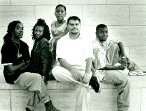
Omari Trice, Megan Yaleh Meaway, JeJuana Johnson, Hector Sanchez, Ryan Benard (was unable to attend)
